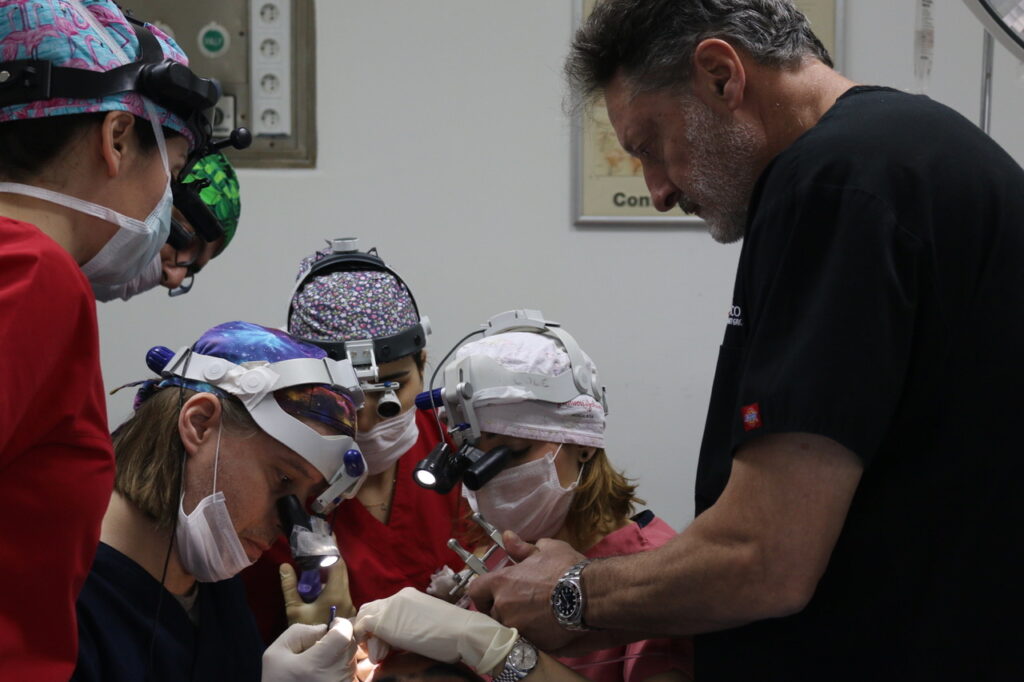
FUE training for doctors at HTTC, the Hair Transplant Training Center at HLC Hairline Clinic in Ankara, runs from a one-day intensive to a programme of up to four weeks. The right length depends on what you already do. As a rule of thumb, a physician new to hair restoration needs more time across the whole clinical workflow, while an FUE surgeon refining one technique may need only a short, focused visit. The length is agreed with HTTC.
Most doctors ask this before anything else, because the answer decides how many days to block and what to budget. This guide sets out what each programme length can cover, gives an example timetable for a three-day course and shows how the length affects the fee. It also explains what a course of any length cannot promise.
Programme length depends on your starting point
HTTC agrees the length and focus of each programme with the participant, based on their experience and training goals. Use the table below as a starting point for that conversation; HTTC may suggest a different length once it knows your background.
| Your starting point | Where the time goes | Length to discuss |
|---|---|---|
| Licensed physician, no hair restoration experience | The complete workflow: consultation, donor assessment, hairline design, extraction, graft handling, implantation and postoperative care | The longer end: one week or more, up to four weeks |
| Surgeon with operating experience, new to FUE | Instrument handling, extraction technique and graft care, then site creation and implantation | Several days to two weeks |
| Practising FUE, refining one area (for example powered extraction with the PCID, implanters or body hair) | One technique in depth, with feedback on your own handling | One to three days, or a focused workshop |
| Returning HTTC participant | A specific topic such as body hair transplantation, donor management or hairline planning | Agreed for that topic |
A shorter visit concentrates on selected techniques. A longer programme gives you more time across the whole workflow and more supervised clinical days. The skill you leave with still depends on where you started, the cases you see and how much you practise afterwards.
What each programme length can cover
Treat this table as a planning guide. What each programme covers is agreed with HTTC and depends on the procedures scheduled during your visit.
| Programme | What the time allows |
|---|---|
| One-day intensive | A focused session on one part of the workflow, with theory, demonstration and supervised practical work arranged around the day’s scheduled procedures |
| Three days | Consultation and planning, manual and powered extraction, graft handling and implantation across several clinical days |
| One week | The full workflow, with time to revisit steps across the cases scheduled that week; Dr. Mustafa from Las Vegas described his one-week training visit at HTTC; other reports are on the alumni page |
| Two to four weeks | Broader work across the clinical workflow, with time for body hair transplantation, repair case discussion and postoperative care |
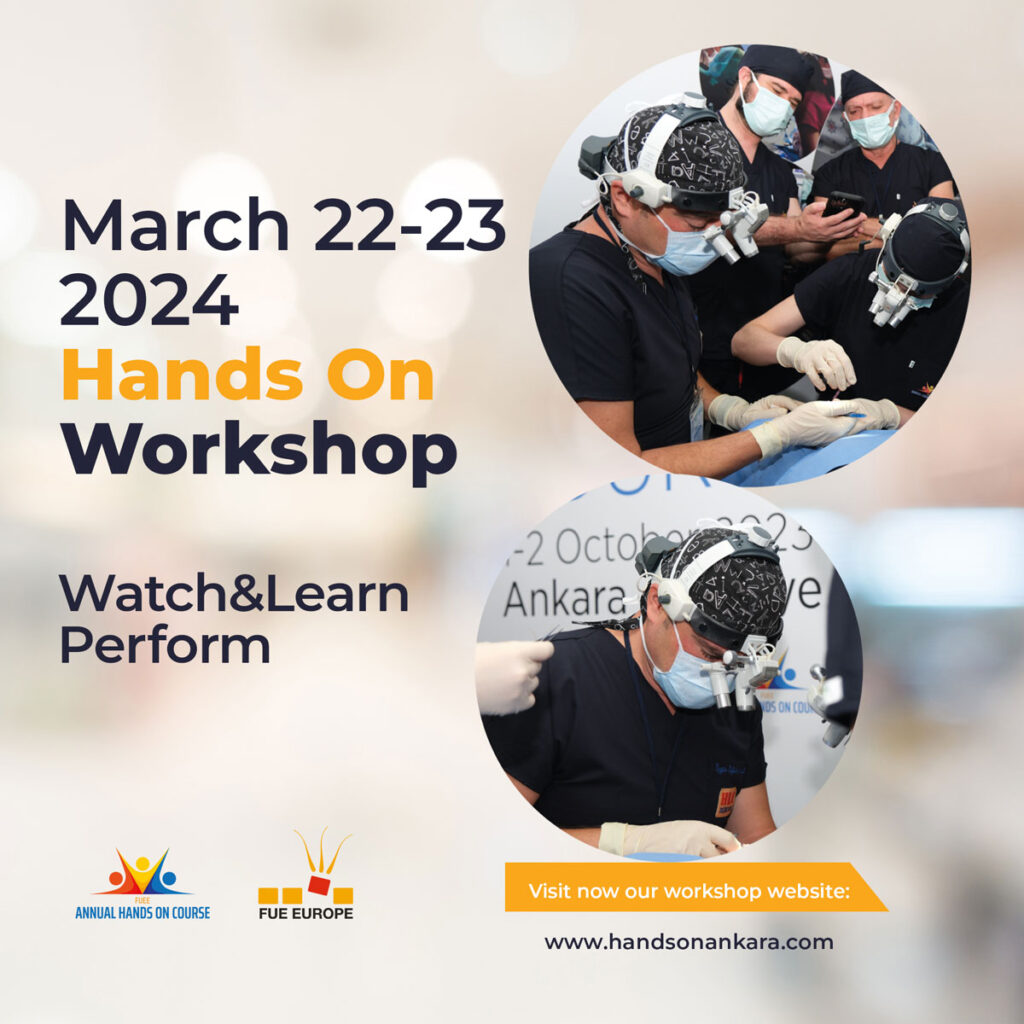
| FUE workshop | A focused session at basic, intermediate or advanced level; duration arranged for the session |
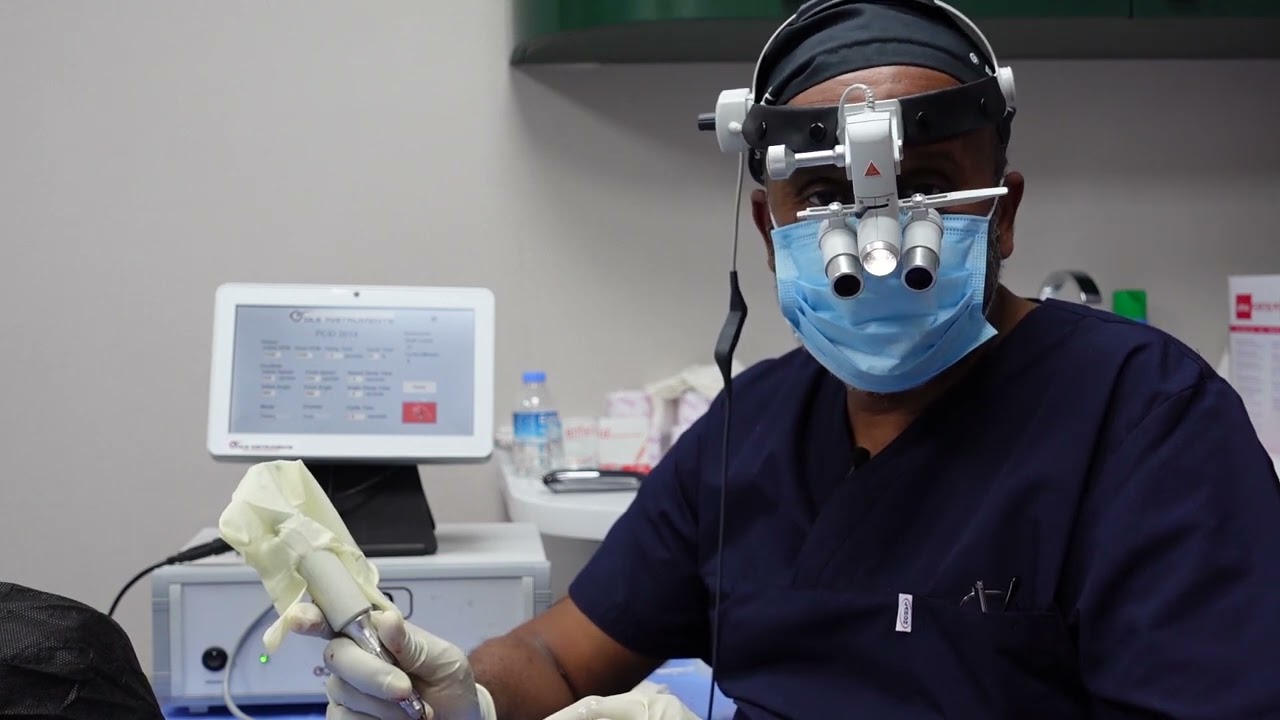
The course outline lists the modules that these programmes draw on.
Example timetable: a three-day FUE programme
Training at HTTC follows real procedures at HLC Hairline Clinic in Ankara, so the days are organised around the procedures scheduled during your visit. The example below shows how the emphasis can shift over three days. It is an illustration with no fixed hours; the day’s cases and your agreed programme decide the order.
Day 1: planning and demonstration
- Theory and case planning: patient evaluation, donor-area assessment, hairline design and the treatment plan.
- Extraction: demonstration by the supervising surgeon; instrument handling under supervision.
- Graft care: examining extracted grafts.
- Implantation: demonstration of site creation and graft placement.
- Case discussion: review of the day’s plan and decisions.
Day 2: extraction and graft handling
- Theory and case planning: punch selection, extraction angle and depth; manual versus powered FUE, including the PCID.
- Extraction: supervised extraction with feedback on your technique.
- Graft care: preparation, storage and handling with the clinical team.
- Implantation: supervised placement with forceps or an implanter.
- Case discussion: feedback on your extraction work.
Day 3: recipient sites, implantation and aftercare
- Theory and case planning: recipient-site creation with lateral slits, micro blades and needles; direction, angles and density.
- Extraction: supervised practice on the steps you want to consolidate.
- Graft care: graft handling linked to the planned placement.
- Implantation: supervised site creation and stick-and-place implantation.
- Case discussion: postoperative care, patient instructions and follow-up; what to practise next.
How much of each step you perform yourself depends on your experience, the patient and the supervising surgeon’s judgement. A one-day intensive compresses this into a single day around one focus. A programme of two to four weeks repeats the cycle on more cases and adds topics such as body hair transplantation.
What happens on a training day
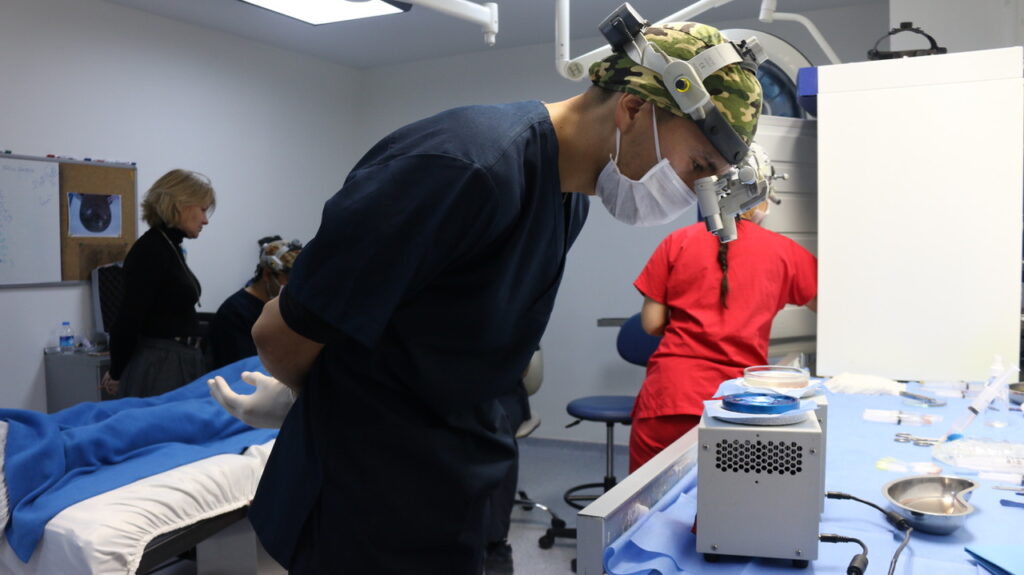
Each day combines a theoretical session and case planning with clinical work. During extraction, teaching covers instrument handling and graft assessment. Implantation sessions cover recipient-site preparation and graft placement. Case discussion connects the practical work with the decisions behind it.
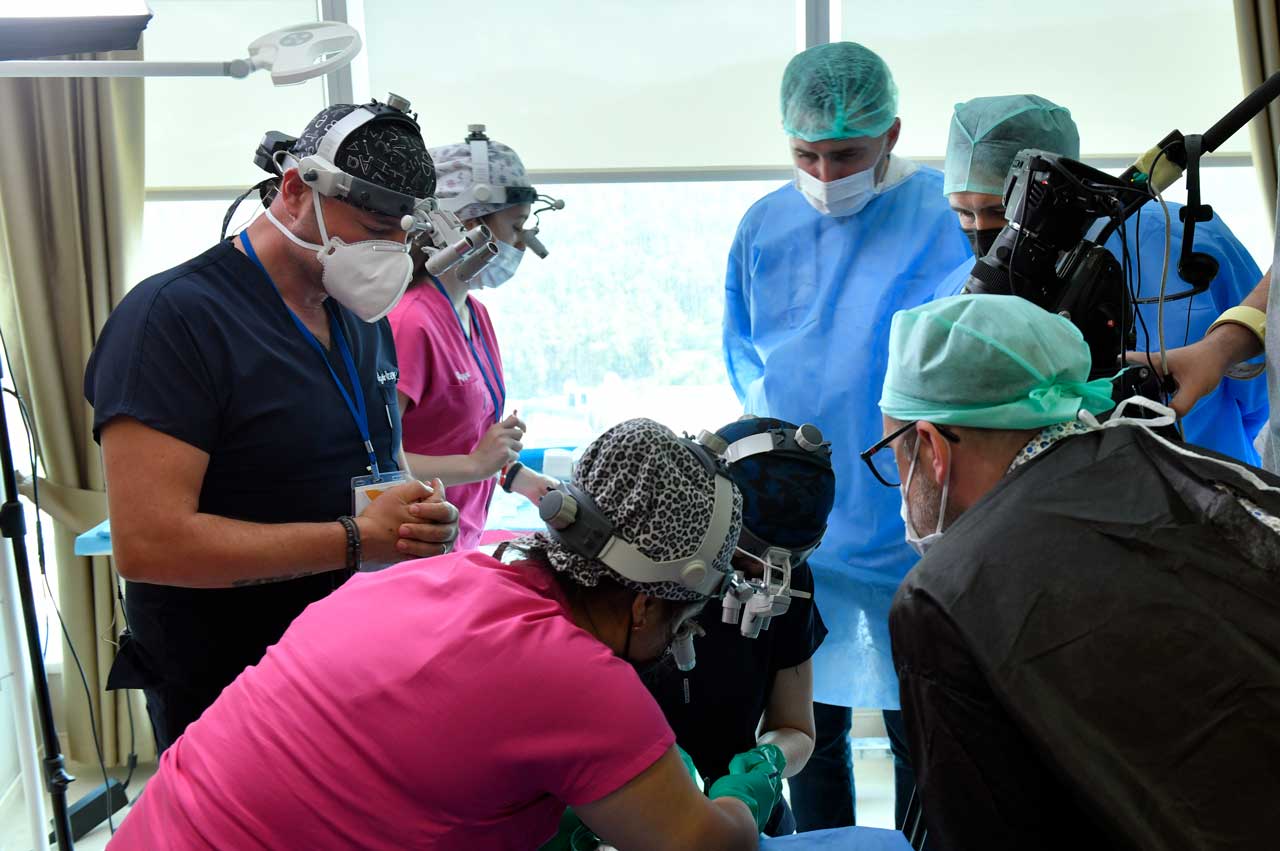
Training includes FUE extraction and implantation on real patients under direct surgeon supervision. You work alongside the supervising surgeon at HLC Hairline Clinic, whose Medical Director, Dr. Özgür Öztan, is a past president of FUE Europe. The training course is one-to-one or in a group of two or three, never more than three. Workshop groups are arranged for each session.
Why FUE takes time to master
A 2010 review in the Journal of Cutaneous and Aesthetic Surgery lists the learning curve among the limitations of FUE: “There is a long learning curve in FUE.” None of the studies we reviewed names a number of cases or days after which a surgeon becomes proficient.
One small study shows how a beginner’s extraction errors can go unnoticed. In a 2016 paper in Dermatologic Surgery, an expert and a beginner each performed FUE on 10 patients. Their transection rates for the extracted grafts were similar, but the rate of hidden transection, damage to follicles left below the scalp surface in the donor area, was 2% for the expert and 8% for the beginner. The researchers found it only by examining donor tissue under a microscope. Two surgeons are too few to set a benchmark, but the study shows that a beginner’s extraction can look as good as an expert’s while causing more damage that stays out of sight.
What no programme length can promise
No number of days turns attendance into independent competence. HTTC does not promise that a participant can operate alone after a fixed number of days, and attendance alone does not establish clinical competence. A course gives you supervised practice and feedback on your own handling, which shows you which steps still need work.
Participants receive an HTTC certificate of completion signed by the instructor. It records the training format, dates, techniques covered, the supervised cases observed or participated in and the training hours. The certificate is recognised by FUE Europe. It is not an ISHRS qualification or a substitute for fellowship accreditation, and you still need the authorisation to practise that applies where you work.
After training, former participants can contact HTTC with technical questions and for case discussion.
Course, workshop or fellowship?
| Format | Typical length | What it is |
|---|---|---|
| HTTC training course | One day to four weeks | Supervised work on real patients, arranged around your goals |
| FUE workshop | Arranged per session | A focused session at basic, intermediate or advanced level; price quoted per session |
| ISHRS fellowship | 9 to 12 months | A structured ISHRS-approved training programme |
Under the fellowship policy of the International Society of Hair Restoration Surgery (ISHRS), each fellow must act as first assistant surgeon in at least 70 cases over a minimum of 9 months. A course gives a licensed physician concentrated, supervised time with the procedure; a fellowship places the trainee in a practice for most of a year. HTTC does not offer a fellowship, and its course is not one.
If you are comparing providers, the guide to choosing an FUE training course lists the questions to ask about supervision, patient responsibility and completion. HTTC is a training provider too, so put the same questions to HTTC.
How the length affects the cost
HTTC charges its training fee per day.
| Programme | Fee for one participant |
|---|---|
| One day | USD 5,000 |
| Three days | USD 15,000 |
| Group of two or three | Package price on request by phone or email |
Hotel accommodation and airport transfers on arrival and departure are included in the training fee. Flights, meals and personal travel insurance are not. Instrument use during the course does not mean equipment is supplied for you to take home. The pricing page lists what the fee covers. Workshop fees are quoted for the proposed session.
How to decide how many days to book
Send HTTC enough information to recommend a length:
- Your qualification and country of practice. HTTC trains licensed physicians and checks credentials during registration.
- Your hair restoration experience so far, including whether you already perform FUE, FUT or other surgery.
- The techniques you want to develop, for example powered extraction, implantation with an implanter or body hair transplantation.
- How much time you have, and your preferred dates.
- Who comes with you. A medical assistant or surgical nurse can attend alongside a physician; you can also attend without one, as the HLC team supports the clinical training.
Agree the dates, format and total fee, and review the payment, cancellation and rescheduling terms before you book flights. The schedule and registration page explains each step.
FAQ
More answers about enrolment, certificates and booking are in the HTTC training FAQ.
How long is a hair transplant training course at HTTC?
HTTC’s hair transplant course duration ranges from a one-day intensive to up to four weeks. HTTC agrees the length and focus with each participant according to their experience and training goals. The pricing page uses a three-day course as its example. Workshops are focused sessions whose duration is arranged for each session.
Can I learn FUE in one day?
A single day can introduce the workflow or focus on one technique, with theory, demonstration and supervised practical work. It is not enough to learn the whole procedure. Physicians new to hair restoration should plan a longer programme and expect to keep practising after it.
Is three days enough for a doctor new to hair transplantation?
Three days can cover consultation, extraction, graft handling and implantation, but only as a first pass through the workflow. For a physician with no hair restoration experience, a week or more gives time to repeat each step on further cases. The final length is agreed with HTTC.
Will I be able to perform FUE on my own after the course?
HTTC does not promise independent competence after a fixed number of days. The course gives supervised practice on real patients and feedback on your technique. Independent practice also depends on your continued training and the authorisation required in your jurisdiction.
How much does each training day cost?
Training costs USD 5,000 per day for one person, so a three-day course costs USD 15,000. Groups of two or three can request a package price by phone or email. Hotel and airport transfers are included; flights, meals and travel insurance are not.
How many doctors train at the same time?
The training course is one-to-one or in a group of two or three participants, never more than three. Workshop groups are arranged for each session. A medical assistant or surgical nurse can attend alongside a physician.
Does a longer course give me a different certificate?
Every participant receives an HTTC certificate of completion signed by the instructor. It records the format, dates, techniques covered, supervised cases and training hours, so a longer programme is documented as such. The certificate is recognised by FUE Europe but does not replace permission to practise.
How long is a hair transplant fellowship?
Under the ISHRS fellowship policy, a fellowship lasts 9 to 12 months. Each fellow must act as first assistant surgeon in at least 70 cases over a minimum of 9 months. A course of days or weeks, like HTTC’s, is a different format.
Do you need to be a doctor to train in FUE at HTTC?
Yes. HTTC trains licensed physicians, including dermatologists, plastic surgeons and general surgeons, and checks credentials during registration. Medical assistants and surgical nurses can attend alongside a physician.
Is the HTTC course a fellowship?
No. HTTC offers training courses and FUE workshops at HLC Hairline Clinic in Ankara, not a fellowship. The certificate is not a substitute for fellowship accreditation.
Sources
- International Society of Hair Restoration Surgery. Policies, Procedures and Guidelines of the Fellowship Training Programs (PDF). Accessed 27 September 2026.
- Dua A, Dua K. Follicular unit extraction hair transplant. J Cutan Aesthet Surg. 2010;3(2):76–81.
- Kim DY, Choi JP, Hwang YJ, Kim HS. Hidden transection of follicular unit extraction in donor site. Dermatol Surg. 2016;42(4):485–488 (abstract).
- HTTC programme details: training course, course outline, pricing and certificate, as published on 27 September 2026.
Plan your training
Tell HTTC about your background, the techniques you want to develop and the time you have. The team will suggest a programme length and confirm dates, instructors and the total fee. Send your training goals to HTTC.